

Asphalt driveway thickness is the single spec that decides whether your new surface lasts fifteen years or starts cracking the first winter a loaded truck parks on it, and it is also the spec most homeowners never think to ask about. Everyone focuses on the top layer they can see, but the number that actually matters is how much asphalt is sitting on how much compacted base, matched to what you are going to drive on it. This post lays out the exact thicknesses we spec on our estimates for passenger cars, RVs, and heavy trucks, why those numbers change with the load, and how the base underneath carries more of the work than most people realize.
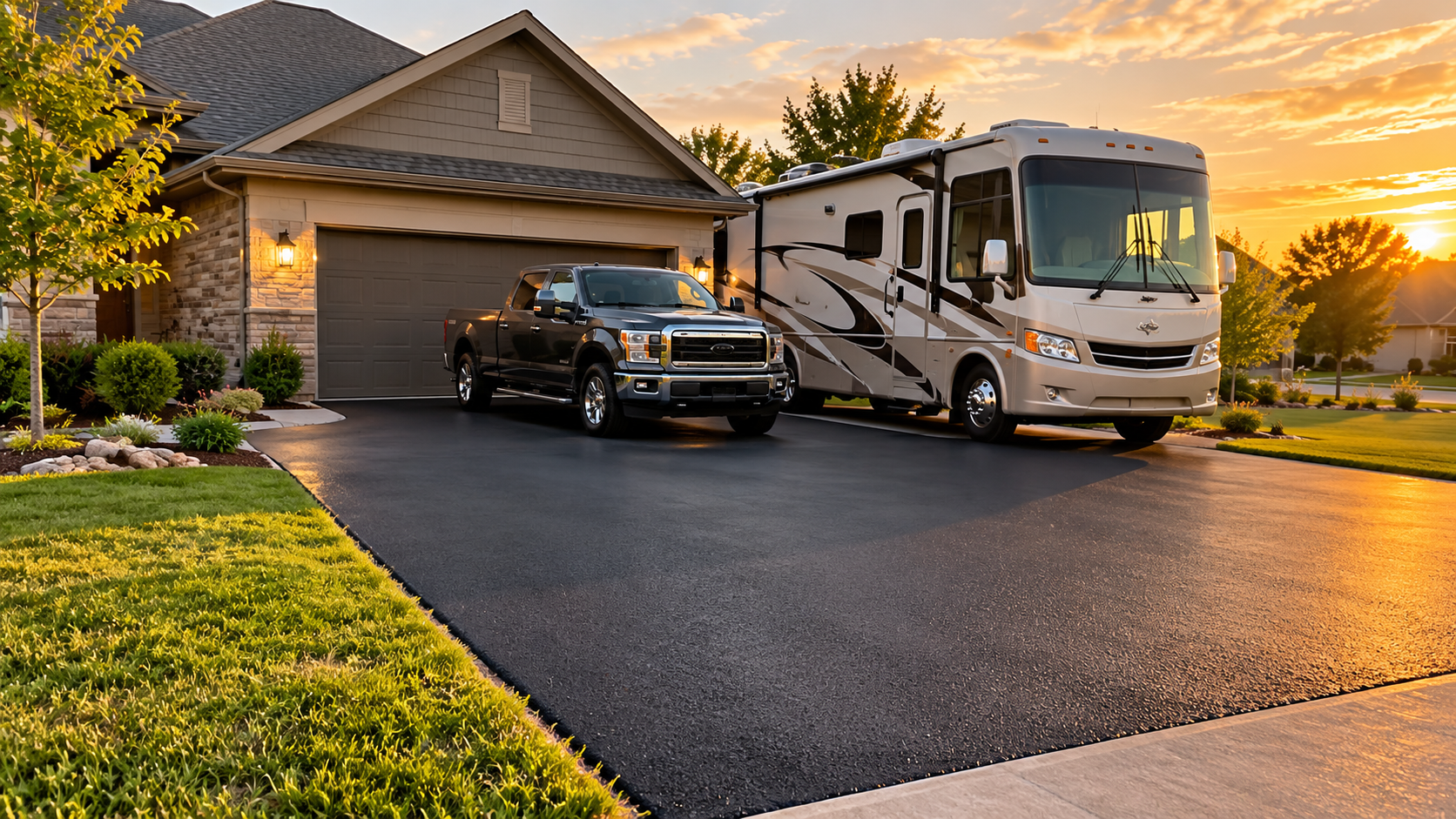
What asphalt driveway thickness do you actually need?
The right asphalt driveway thickness depends on one thing above everything else: the heaviest vehicle that will regularly sit on or roll across it. A driveway that only sees two sedans and a minivan has very different needs from one that parks a 14,000 pound motorhome or takes a loaded dump trailer a few times a month. We do not spec a single number for every job, and any contractor who quotes you “a driveway” without asking what you drive is guessing.
There are two ways to build the asphalt itself. A full-depth build places asphalt directly on a prepared and compacted aggregate base, which is what we do for almost every new residential driveway. An overlay puts a fresh layer of asphalt paving over an existing sound surface, which is thinner because the old pavement is acting as part of the structure. The thickness targets below are for the compacted asphalt, meaning what is left after rolling, not the loose depth that goes down before compaction.
How thick should an asphalt driveway be for cars, RVs and trucks?
Here is the spec table we work from on residential and light commercial jobs in the Springfield area. These are our standard starting points, adjusted up when the soil is poor or the loads are at the top of a range.
| Use case | Compacted asphalt | Aggregate base | Notes |
|---|---|---|---|
| Resurface / overlay over sound pavement | 2 inches | Existing surface | Only when the old base is still solid |
| Standard car and light truck driveway (full-depth) | 3 inches | 4 to 6 inches | Our most common residential build |
| RV, boat trailer, heavy pickup parking | 3 to 4 inches | 6 to 8 inches | Extra base depth matters most here |
| Commercial drive lane / heavy trucks | 4 inches or more | 8 inches or more | Often placed in two lifts |
A few things stand out when you look at that table. The asphalt itself does not grow as fast as people expect between a car driveway and an RV pad. What grows is the aggregate base underneath. That is because asphalt is flexible pavement, and its job is to spread the load down into the base and the soil. Build it thin over a weak base and even a 3 inch top layer will flex, fatigue, and crack. This is exactly the principle the Asphalt Institute thickness-design tables are built on: pavement structure is the total system, not just the black you see.

Why does the base depth matter as much as the asphalt?
If we could only get one part of a driveway right, we would pick the base every time. On our estimates we spend more words explaining base depth than asphalt paving thickness, because that is where most failures actually start. The compacted aggregate base does three jobs at once:
- It spreads the load. A tire’s weight fans out through the base so the soil underneath never sees the full point load. More base means a wider spread and less stress on the subgrade.
- It drains water away. A clean crushed-stone base lets water move through and out instead of sitting under the asphalt. Water trapped in the base is the number one cause of premature cracking in our climate.
- It gives a stable platform to compact against. You cannot properly compact asphalt over soft, pumping soil. The base has to be solid and rolled before a single load of hot mix shows up.
Our Springfield-area clay soils make this non-negotiable. Clay holds water and moves with freeze-thaw, so skimping on base depth or placing asphalt over unprepared subgrade is how you get a driveway that looks great in October and shows edge cracks by spring. Getting the subgrade and base right is why proper excavation services and grading are part of a real driveway quote, not an upsell.
How does vehicle load change the thickness you need?
The jump from a car to a heavy truck is not linear, and the base is where the extra load gets absorbed. A passenger car puts roughly 1,000 pounds through each tire. A loaded three-quarter-ton pickup or an RV can more than triple that per axle, and a loaded commercial truck goes far higher. Because asphalt is a flexible system, we answer that heavier load mostly by building a deeper, stronger base and bumping the asphalt a lift thicker, rather than by pouring one giant slab of asphalt.
- Cars and light SUVs: 3 inches of asphalt on 4 to 6 inches of base handles this all day.
- RVs, boats, and heavy pickups: keep the asphalt at 3 to 4 inches but push the base to 6 to 8 inches, especially where the vehicle sits parked for long stretches.
- Commercial and truck traffic: 4 inches or more of asphalt, often in two lifts, over 8 inches or more of base, with extra attention to the subgrade.
Where a heavy vehicle sits still matters as much as where it drives. A motorhome parked in the same spot for weeks concentrates a huge static load on one area, so we often reinforce just the parking pad with extra base even on an otherwise standard driveway. These are the judgment calls we make in person, which is why our asphalt paving estimates always start with what you actually park.
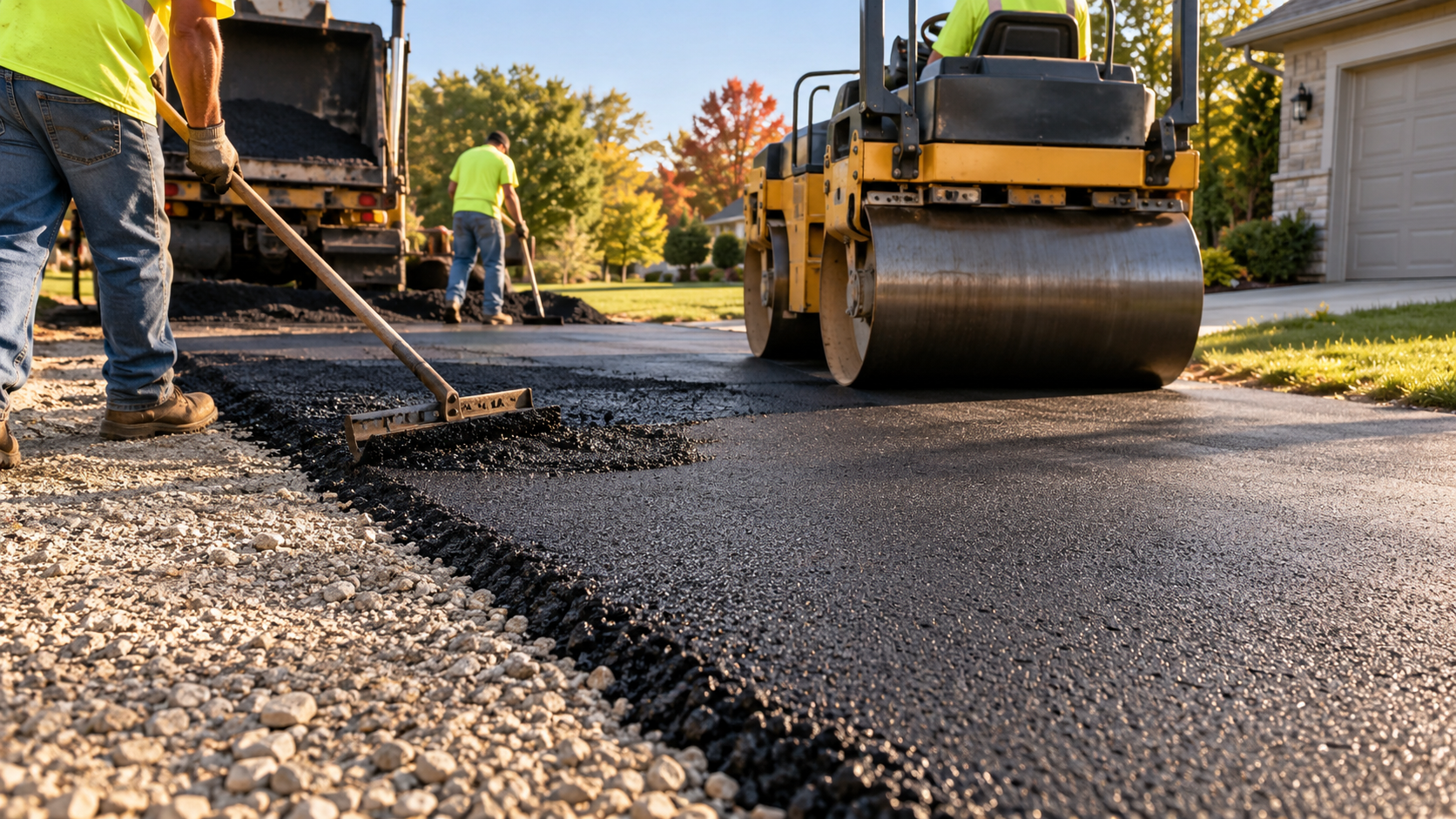
Can you just add a thicker top layer instead of more base?
This is the most common shortcut homeowners ask about, and the honest answer is usually no. Piling on a thicker asphalt layer over a thin or poorly compacted base does not fix the real problem, it just adds cost while the weak layer underneath keeps moving. Full depth asphalt still relies on the subgrade being prepared and the pavement being thick enough as a system. There are times a two-lift asphalt build is the right call for heavy loads, but that is a deliberate structural choice, not a substitute for doing the base work. We would rather dig out and build the base correctly once than pave twice.

Frequently Asked Questions
Is 2 inches of asphalt enough for a driveway?
Two inches is an overlay thickness, appropriate only when it is going over an existing pavement that still has a sound base and surface. For a brand new full-depth driveway, 2 inches is too thin and will crack early. Our standard new-build residential spec is 3 inches of compacted asphalt over a properly prepared aggregate base.
How thick should the base be under an asphalt driveway?
For a standard car driveway we target 4 to 6 inches of compacted aggregate base. For RVs, heavy pickups, and trailers we go 6 to 8 inches, and for commercial or truck traffic 8 inches or more. The weaker the soil, the more base you need, and our clay soils usually push us toward the higher end.
What thickness do I need for an RV or motorhome pad?
We keep the asphalt at 3 to 4 inches but focus on the base, usually 6 to 8 inches, because a parked RV concentrates a heavy static load in one spot for a long time. We will often reinforce just the parking area with extra base depth so the surface does not depress over time.
Does asphalt thickness really affect how long my driveway lasts?
Yes, but as part of the whole structure. Correct asphalt paving thickness over a properly built and drained base can last fifteen to twenty years or more. The same asphalt over a thin, wet, or poorly compacted base can start failing within a couple of seasons no matter how good the surface looked on day one.
How do you decide the exact thickness for my driveway?
We look at the heaviest vehicle you will run on it, the condition and type of your soil, drainage and slope, and whether we are building new or overlaying. Then we match it to the thickness-design approach used across the industry. Every number lands in your written estimate so you can see exactly what you are paying for.
Get a Free Written Estimate
Not sure how thick your driveway needs to be for what you drive? Tell us what parks on it, from a daily sedan to a 40 foot motorhome or a loaded work truck, and we will come measure, check your soil and drainage, and put the exact asphalt and base thickness in writing. No guesswork, no upsell.
Asphalt Pavers LLC, 434 S Belcrest Ave, Springfield, MO 65802
(417) 319-2693 · Mon-Sat 8:00 AM-5:00 PM
View us on Google Maps
Reviewed by the owner – October 9, 2026