

Knowing the fire lane requirements Springfield businesses have to meet before an inspection is the difference between passing on the first visit and eating a re-inspection fee plus the cost of repainting on a deadline. Fire lanes are not a suggestion from your local fire marshal; they are code-driven access routes that have to be clearly marked, correctly worded, and wide enough for an engine to work. We have re-striped a lot of commercial lots in town right before an inspection, and the same handful of problems come up every time. This guide lays out what the code actually says, what inspectors flag most on Springfield properties, and how to get your markings right the first time.

What are the fire lane requirements Springfield inspectors check?
The fire lane requirements Springfield businesses fall under come from the International Fire Code that the city has adopted, with the fire marshal’s office enforcing it locally. At a high level, an inspector is confirming three things: that a compliant fire apparatus access road exists and reaches the building, that the lane is clearly marked so no one parks in it, and that the route stays unobstructed year round. The code sets the baseline numbers, but the fire marshal has authority to require markings and signage specific to your site, which is why two lots down the street from each other can get slightly different instructions.
The published standards most of this traces back to live in the International Code Council fire code, and the local enforcement details come through the City of Springfield fire marshal’s office. When we quote fire lane striping, we build to the code minimums and then confirm any site-specific wording the marshal wants before our crew ever opens a paint can.
Fire lane width and access road dimensions
The single most common question we get is how wide a fire lane has to be, and the answer under the fire code is an unobstructed width of at least 20 feet, with at least 13 feet 6 inches of vertical clearance for anything overhead like a canopy or sign. Where the access road runs alongside a building taller than 30 feet, that required width jumps to 26 feet to allow for aerial ladder setup. The road also has to be built to carry the weight of a fire apparatus, which for a loaded engine means a surface rated well above what a passenger car needs.
| Requirement | Code minimum | Notes |
|---|---|---|
| Unobstructed width | 20 feet | 26 feet where building exceeds 30 feet tall |
| Vertical clearance | 13 feet 6 inches | Watch canopies, drive-thru overhangs, signage |
| Turning radius | Per fire marshal | Must accommodate the responding apparatus |
| Surface | All-weather, load rated | Must support fire apparatus weight |
| Marking color | Red curb or pavement | With white lettering, per local direction |
Those numbers are the baseline, but grade, turning radius, and dead-end turnaround requirements come into play on tighter sites. If your lot was striped years ago to an older standard, there is a real chance the lane is narrower than current code, which is the kind of thing that gets caught on a re-inspection after a remodel.

Fire lane striping and marking rules
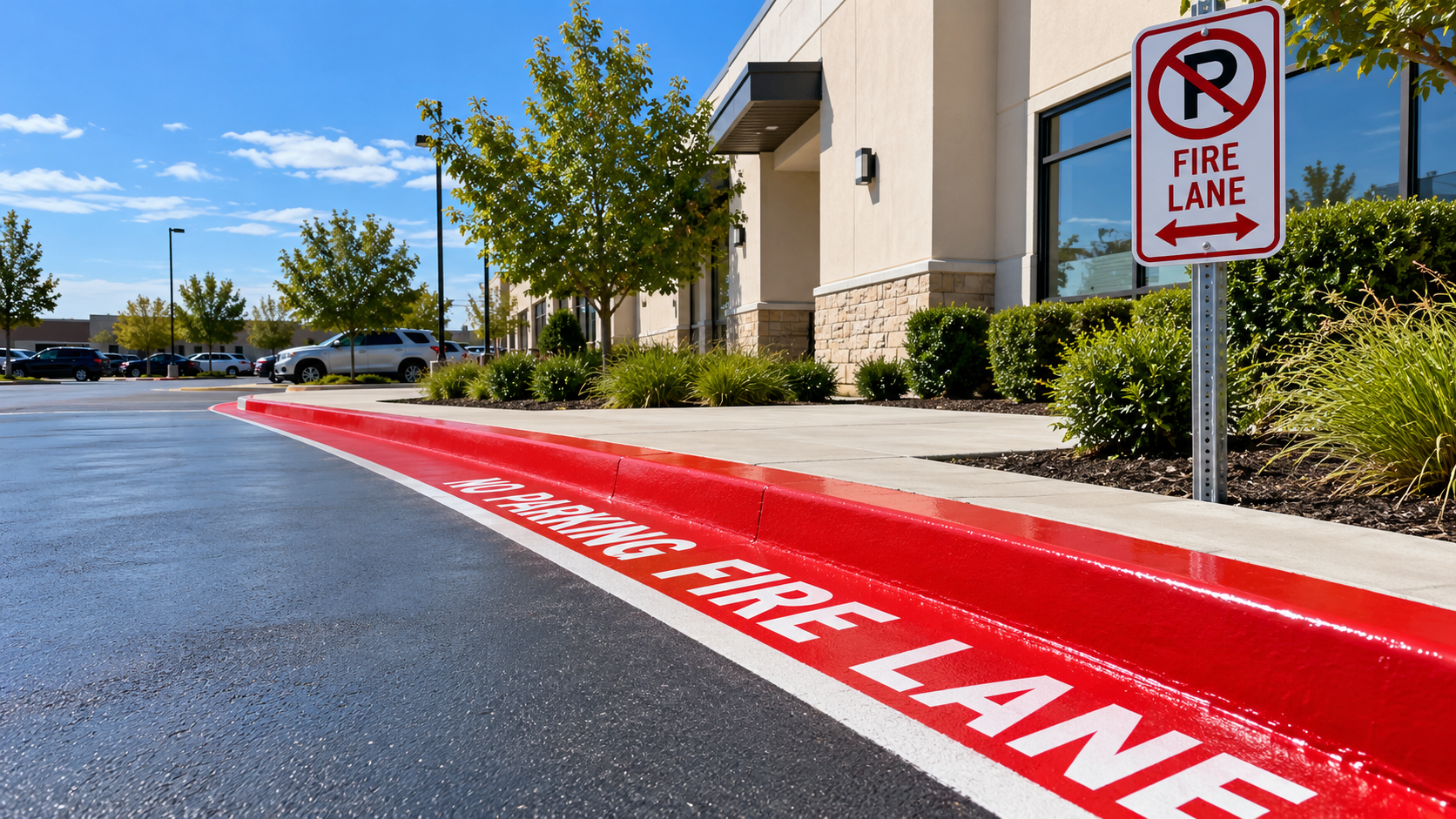
Marking is where most Springfield properties actually fail, and it is the cheapest part to get right. The fire code requires that fire apparatus access roads be marked so they are plainly visible and that the marking be maintained. In practice, for the lots we stripe that means a continuous red line or red-painted curb along the designated lane, paired with white stenciled lettering reading NO PARKING FIRE LANE at intervals so the message is readable no matter where a driver stops. The exact spacing and whether the paint goes on the curb, the pavement, or both is a detail the fire marshal specifies, which is why we confirm it before mobilizing.
- Color. Red is the standard for fire lane markings, with white lettering for contrast and legibility.
- Wording. NO PARKING FIRE LANE is the typical required legend, stenciled in capital letters tall enough to read from a moving vehicle.
- Spacing. Lettering repeats down the lane so the restriction is clear along its full length, not just at the ends.
- Signage. Posted signs usually accompany the pavement markings, and the fire marshal may require specific sign language and placement.
- Maintenance. Faded paint is a violation. Markings have to stay legible, which on a busy lot means re-striping every few years.
Getting the color, wording, and spacing right is exactly the kind of work our crew handles on a fire lane striping job, and we coordinate it alongside the rest of your line marking so the whole lot reads clearly and consistently.
What inspectors flag most on Springfield lots
After enough pre-inspection calls, we can almost predict what the fire marshal will write up. The issues are rarely dramatic; they are small lapses that add up to a failed inspection. Here is what we see get flagged over and over on Springfield commercial properties.
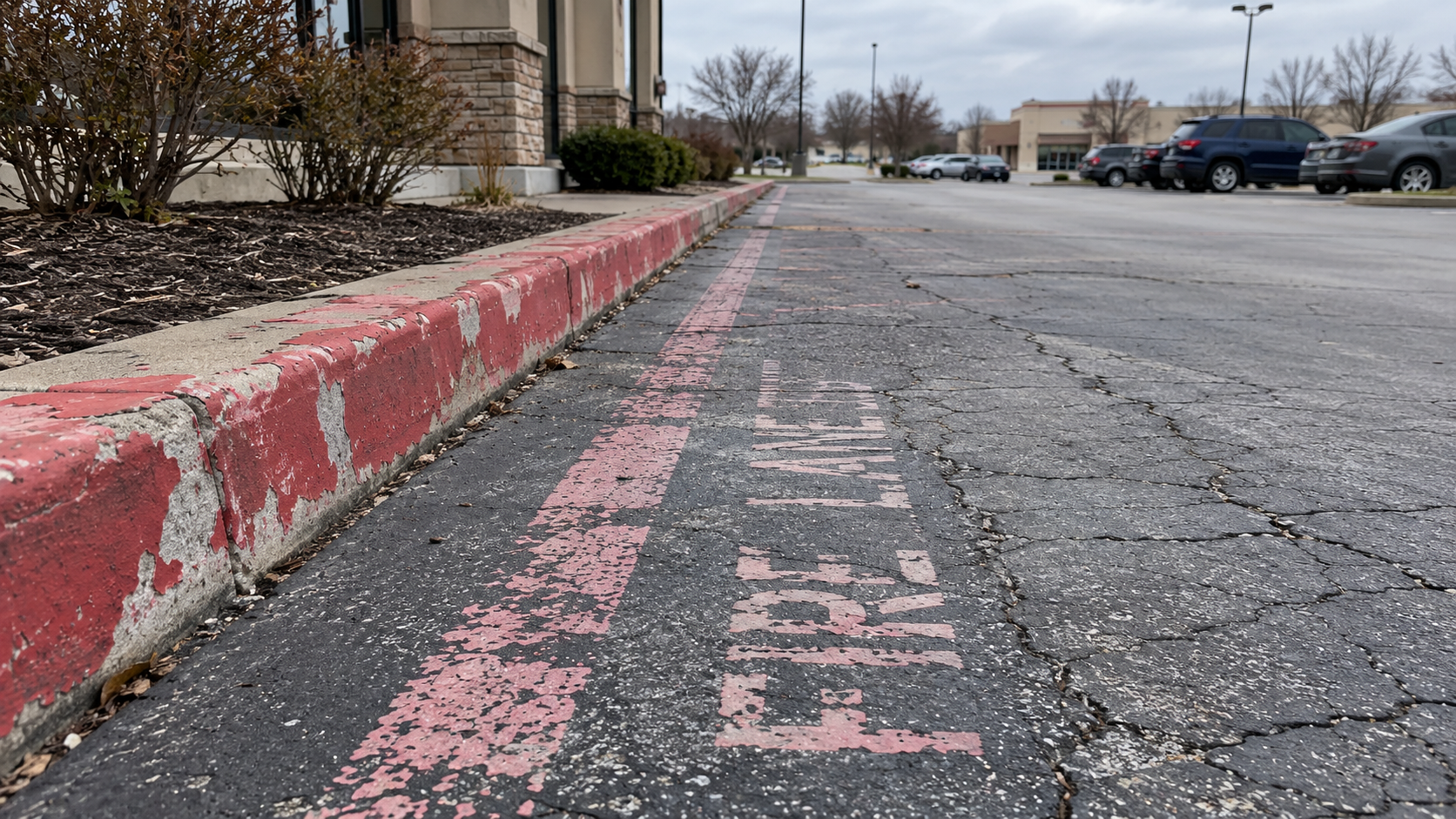
- Faded or worn markings. Red paint that has sun-bleached to pink or lettering worn down by plows and traffic no longer counts as clearly marked.
- Missing or illegible signage. Signs that were knocked down, never replaced, or weathered past reading.
- Obstructions in the lane. Dumpsters, parked trailers, pallet storage, or seasonal displays sitting in the access route.
- Lane too narrow. Older striping that no longer meets the 20 foot width, often after a lot was re-striped for extra parking stalls.
- Vertical clearance problems. New canopies, banners, or drive-thru structures that dropped below 13 feet 6 inches.
The good news is that nearly all of these are fixable fast once they are identified. Most of what fails an inspection is a paint and signage problem, and a crew that knows the code can turn a lot around well before the re-inspection date.
How to pass your fire lane inspection the first time
The smartest move is to get ahead of the inspection rather than scrambling after a failure. We recommend walking your lot the way an inspector would: start at the street, follow the access road to the building, and ask whether an engine could reach it unobstructed at full width with clearance overhead. Check that every stretch of the lane carries legible red markings and repeated NO PARKING FIRE LANE lettering, that signs are standing and readable, and that nothing is stored in the lane. If your markings are faded, narrow, or missing the required wording, schedule the re-striping before the inspector arrives, not after.
When a property manager calls us before an inspection, we do that walk with them, note what is out of compliance, confirm the current requirements with the fire marshal’s office if there is any question, and put a clear scope in writing. That way the fix is done once, to code, and the inspection becomes a formality. If you want that walkthrough on your property, reach out through our contact page and we will come look at the lot.
Frequently Asked Questions
How wide does a fire lane have to be in Springfield?
Under the fire code the city enforces, a fire apparatus access road needs an unobstructed width of at least 20 feet, increasing to 26 feet where the building is taller than 30 feet. Vertical clearance has to be at least 13 feet 6 inches. The fire marshal can add turning radius and turnaround requirements based on your specific site, so we confirm the details before striping.
What color and wording are required for fire lane markings?
Fire lanes are marked in red, either on the curb, the pavement, or both, with white lettering reading NO PARKING FIRE LANE repeated along the lane. The exact placement and spacing is set by the fire marshal, which is why we verify the local requirement before painting. Markings also have to be maintained, so faded red paint is treated as noncompliant.
Why do Springfield businesses fail fire lane inspections?
The most common reasons are faded markings, missing or illegible signs, obstructions like dumpsters or trailers in the lane, lanes that have been narrowed below 20 feet, and overhead clearance that dropped below 13 feet 6 inches after a canopy or sign went up. Almost all of these are quick fixes once an inspector or a knowledgeable crew points them out.
How often do fire lane markings need to be repainted?
There is no single interval in the code, but the rule is that markings must stay clearly visible and legible. On a busy lot with heavy traffic, UV exposure, and winter plowing, that usually means re-striping every two to three years. If your red paint has faded toward pink or the lettering is wearing off, it is time to redo it regardless of the calendar.
Can you re-stripe a fire lane before a scheduled inspection?
Yes, and that is a common call for us. If we have clear weather and the surface is sound, fire lane re-striping is fast, and we schedule around your business hours so you stay open. The key is to call with enough lead time to let the paint cure and to correct any width or clearance issues, not just repaint. Bring us in before the inspection and the fix gets done once, to code.
Get a Free Written Estimate
Inspection coming up? We will walk your lot, flag anything out of compliance, confirm the current requirements with the fire marshal if needed, and put honest numbers in writing for fire lane striping, signage, and any width or clearance fixes. Pass the first time, not the second.
Asphalt Pavers LLC, 434 S Belcrest Ave, Springfield, MO 65802
(417) 319-2693 · Mon-Sat 8:00 AM-5:00 PM
View us on Google Maps
Reviewed by the owner – October 5, 2026